


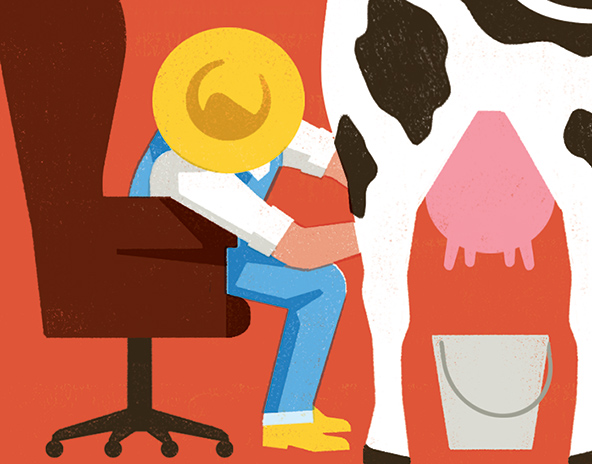
 (Illustration by Chris Gash)
In recent years, corporate America has waged a public-relations crusade to uphold its image among cynical consumers, angry environmentalists, and grandstanding politicians. Companies claim that they can steward nature, show compassion to workers, improve the well-being of their customers, and sustain the communities they operate within.
But to serve the interests of all these stakeholders, much of corporate America would have to abandon the very business models that drive so much of their profits. For some companies, such a step would call their very existence into question. If Facebook and YouTube, for instance, were to change their algorithms so that misinformation and hateful content—clickbait that garners high engagement but often harms its users—were removed or demoted, advertising revenues would drop.
Top business schools and promoters of “conscious capitalism” claim that serving the interests of all stakeholders is good for business and will generate better returns over the long run. This claim makes intuitive sense. A business that doesn’t serve the interests of its customers, suppliers, employees, or community is likely to be a business in decline, stakeholder theorist Edward Freeman has argued. But what happens if that business wields such concentrated market power that those very customers, suppliers, and employees have limited options to buy, sell, or work? Users of social media, for example, are restricted to one or two platforms to stay connected to their wider communities. Commodity farmers and textile manufacturers often have access to no more than one buyer for their goods. Underskilled workers often find opportunity only within a narrow band of industries and employers. Economists describe these situations as market failures. Such concentrated corporate power constricts the choices of other stakeholders and enables corporations to ignore or even harm them while generating outsize profits.
Market failure is pervasive in the United States today. According to a 2019 study, 75 percent of US industries have become more concentrated over the past two decades. Just five technology companies now account for 24 percent of the S&P 500’s market value. The COVID-19 pandemic has only exacerbated the split between corporate profits and stakeholder welfare: The stock market is at an all-time high, while unemployment, inequality, and environmental devastation run rampant.
Such dysfunction is predictable. In capitalist societies, the winners tend to win big, and their gains can be self-perpetuating. Moreover, technological advancement diminishes the demand for labor and allows those with capital to generate wealth at a much faster rate than other stakeholders, one of the principal warnings of Karl Marx and, more recently, economist Thomas Piketty. This dynamic generates and reinforces a dangerous power asymmetry, where shareholders, via the boards and management teams they appoint, can suppress the interests of other stakeholders and influence the state to serve their interests. Over time, the system erodes value for society as a whole.
Today, 80 percent of public company stock in America is owned by faceless institutional investors. They control a majority of voting rights and appoint most board directors. In spite of significant capital flowing into impact funds and constant discourse on “ESG” (environmental, social, governance) investing, there is little acceptance that truly supporting the interests of other stakeholders might require compromising on shareholder returns, at least in the short run. Rectifying our current malaise will require more than proclamations from corporations and asset managers or new theories from business schools. It will demand systemic reforms that promote a shift in ownership and decision-making authority to other stakeholders.
Softening Capitalism
Over the past century, capitalist societies have relied on a range of approaches to protect stakeholder interests. Governments have established regulations and a body of institutions to enforce them. The United States, for example, set up the Food and Drug Administration (FDA) in 1906 to protect consumers and the Environmental Protection Agency (EPA) in 1970 to protect the health of communities and the environment.
Progressive lawmakers today are calling to strengthen these institutions and pass new legislation, such as raising the minimum wage, mandating paid leave, and taxing carbon emissions. While such laws would augment stakeholder protections, legal reforms have their limits. For one, markets are increasingly complex, making it harder to legislate or predict every possible shareholder abuse. Moreover, big corporations, through lobbying and campaign contributions, already wield too much influence over legislators.
Over the past several decades, a new crop of social entrepreneurs has emerged, intent on using business as a vehicle to solve some of the world’s biggest problems, usually by placing a spotlight on one or more stakeholders. They are making microloans available to disadvantaged communities, bringing the formerly incarcerated onto their payrolls, and helping farmers improve productivity. They maintain that businesses can generate profits for shareholders while simultaneously serving a social mission for other stakeholders. Clothier Patagonia, for instance, has a mission to “save our home planet.” Eyewear retailer Warby Parker aims to make glasses affordable and provides free pairs to the poor.
In a legislative nod to these social or purpose-driven enterprises, a number of US states have established a new legal structure called the public benefit corporation (PBC). Companies that elect to be PBCs must define a positive impact they intend to have on one or more categories of people, communities, or the environment. But there are limitations here too. There is little legal recourse for stakeholders if benefit corporations do not live up to their charters, and statutes don’t generally define how specific the public benefit needs to be. It is also unclear whether benefit corporations can create systemic reform. Electing to be a PBC is optional, making their very incorporation dependent on the benevolence of shareholders and their management teams.
A more powerful model for systemic reform comes from stakeholders themselves sharing the reins of corporate governance. In a number of noteworthy cases, farmers, customers, and employees have joined to become the majority shareholders of major businesses. For instance, Organic Valley and Amul, the largest dairy brand in India, are owned by their farmers. Recreational Equipment, Inc. (REI), and New York Life Insurance are owned by their customers. John Lewis, a successful retailer in the United Kingdom, and Mondragon, one of the largest conglomerates in Spain, are owned by their employees.
In these cases, the dynamics of decision-making fundamentally change, as the owners wear multiple stakeholder hats, making it conceivable for profit and social good to go hand in hand. Organic Valley offers price protection to farmers when milk prices drop. In the early months of the pandemic, Mondragon had to drop production capacity by 75 percent but was able to get by with no layoffs and just a 5 percent cut in pay. When stakeholders are owners of the business, their interests directly influence its decisions.
Stakeholder Ownership
Mandating a redistribution of corporate ownership might not be tenable, but governments could provide meaningful support or incentives. For example, tax incentives could be offered to companies that significantly increase stakeholder ownership. Private equity firms could be given low-interest loans or tax breaks to finance stakeholder-driven buyouts. Several mission-driven private equity firms, such as the Fund for Employee Ownership at the Evergreen Cooperatives, are dedicated to financing worker buyouts.
Congress passed a bipartisan bill in 2018 that expands the Small Business Administration’s authority to finance worker buyouts of up to $5 million. Legislators could build on this start by allowing larger transactions and expanding the covered class to include other stakeholders such as suppliers and customers. Shareholders would benefit, too; evidence suggests that increasing employee ownership also boosts profits. Currently, about 10 percent of Americans hold equity stakes in their workplaces.
The Biden administration should push for legislation that requires public companies to allocate a significant percentage of voting rights and board seats to other stakeholders. Voting rights would enable stakeholders to participate in major decisions such as a sale of the company, and board representation would give them decision-making authority on strategy and budgeting. Germany, for example, requires that workers at large corporations elect half the members of supervisory boards, which make high-level strategic decisions.
Of course, this step would not eliminate every corporate scam. In the Volkswagen emissions scandal, in which the EPA found in 2015 that the company had programmed the emissions controls for its diesel engines to cheat clean air standards, both workers and shareholders had the same incentive to swindle regulators. But the German system has minimized job losses, raised wages, and helped foster a longer-term approach to building businesses. Most important, it hasn’t undermined corporate dynamism. Germany today ranks as the most innovative country in the world, according to the Bloomberg Innovation Index, while America is generating start-ups at the lowest rate since the 1970s.
The Volkswagen case highlights the need for boards to consider a variety of stakeholders such as customers or members of their community. For instance, if users had representation on the board of Facebook, the company might have a different policy for how it applies algorithms that escalate the spread of misinformation. Facebook has set up an oversight board to help moderate content decisions, but that board is effectively appointed by Facebook and could be dismantled at any time. Facebook is the ultimate symbol of power asymmetry. One person—Mark Zuckerberg—owns just 13 percent of the company’s stock but controls nearly 58 percent of its voting rights.
Not since the Gilded Age have corporations wielded so much power, and behind the curtain, decision-making currently rests with a small number of shareholders that have but one interest. The first step to a more equitable society is to ensure that power is more equitably distributed across all the stakeholders that make up that society. Shareholders and boards are currently where that power resides. Making them more inclusive is key to making stakeholder capitalism work, and perhaps to saving capitalism itself.
Read more stories by Hans Taparia.